01
The shortage needs investigation
Before raising an order, the team needs the BOM, available inventory and supplier context behind the request.
Operations & Manufacturing
Purchasing, supplier records, parts, inventory, manufacturing and serialized units alongside quality and project work. Keep the operating context close to the decision.
Built for hardware and operations teams that need to coordinate suppliers, parts, builds and serialized units.
Read-only demo · no signup · sample data only
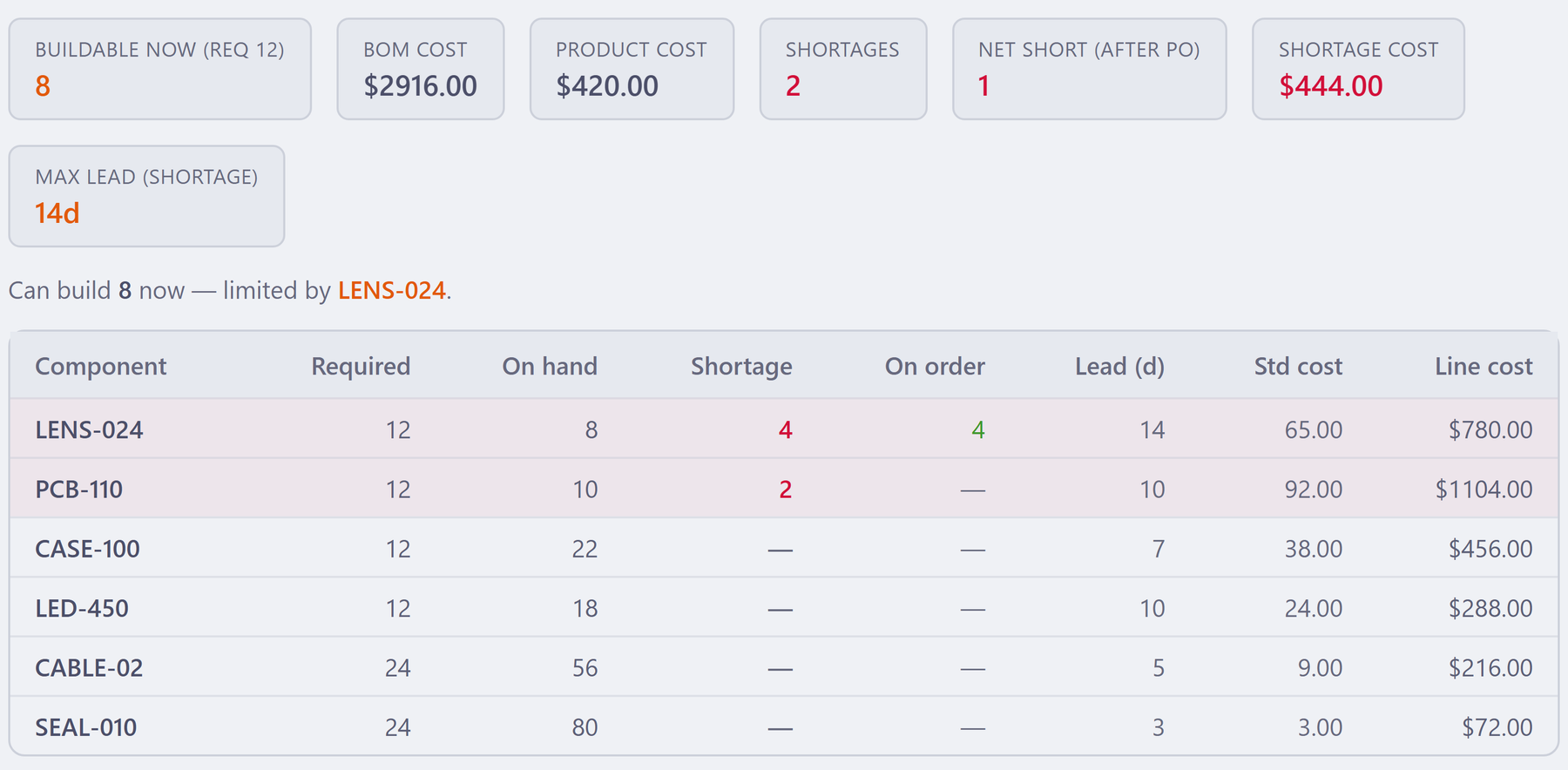
Scroll the interface sideways to inspect the detail.
The sample has stock for eight of the twelve requested units.
Compare required, on-hand and open-order quantities by component.
Use the uncovered shortage to guide the purchasing discussion.
For the people who plan and build
Bring BOM requirements, stock, open orders and work-order status into the operations workspace. Keep the records behind the next build close to the team.

Where work gets stuck
Purchasing, production and quality need to understand the same part, supplier and unit from different perspectives.
Before raising an order, the team needs the BOM, available inventory and supplier context behind the request.
Build records, inspections and field events can live apart. Finding a serial number should be the beginning of the investigation, not the end.
A rollout needs agreement on purchasing, inventory and financial responsibilities, plus the systems and exports the business will retain.
A workflow to evaluate
Start with a BOM or shortage, inspect the supplier and purchase, then follow a unit into its build and field history. Customer 360 is included within Operations.
Keep vendor identity, risk, qualification and scorecards together. Review approved-vendor relationships before purchasing a part.
Work with purchase orders and their approval status. Follow the related supplier and receiving records when an order needs attention.
Maintain the parts master and bill of materials, inspect inventory and availability, and review planning requirements before committing a build.
Manage manufacturing orders and work orders through their status lifecycle. Keep execution work close to the parts and units involved.
Follow unit genealogy and the Unit 360 timeline across build, quality and field records. Inspect the source and matching context behind a connection.
Bring budgets, ledger, receivables and Customer 360 into the same platform. Review posting configuration and financial scope with your accounting owner.
Bring this to your walkthrough
Use a sample BOM, supplier list and purchasing workflow. Include your finance owner to review accounting configuration, exports and the systems you intend to retain.
Connected by design
Project, quality, Operations, HR and controlled-document solutions are included in one platform plan. Evaluate the records, roles and handoffs your team needs to bring together.
Review supplier qualification and findings together with the purchasing work.
Follow a serial through Unit 360 and inspect the source context of connected events.
Review project budgets and financial configuration with the people accountable for delivery and the books.
Make the walkthrough useful
Use a representative build to evaluate data, purchasing roles and unit history. Include your finance owner to agree accounting scope and rollout boundaries.
Browse all nine solutions →